
General Knowledge
On this page
Sometime ago I got a quote from a tradie for some work - around five times what everyone else had quoted. I asked a friend why, and they said: "that's an 'I don't want to do this job' quote."
That sprang to mind recently when a client asked about a level premium policy. So in my role supporting Keep's clients, I pulled 20 years of premium projections from seven insurers to find out whether level premiums actually deliver what they promise.
The short answer: it depends heavily on which cover you're buying, and for death cover at age 45 the case is weak.
Premium structures
What Level and Stepped Premiums Actually Mean
A stepped premium is recalculated every year based on your age at that renewal. Because the chance of a claim rises as you get older, so does the premium. It starts cheap and climbs, gently at first and steeply from your fifties onward.
A level premium is calculated once, at your age when the policy starts, and holds that rate until a set age - usually 65, sometimes 70 - at which point it converts to stepped. You pay substantially more in the early years and substantially less in the later ones.
Level does not mean guaranteed
The premium is level with respect to your age, not with respect to repricing. Insurers retain the right to lift the underlying rates for everyone in a product, and several have done exactly that. The industry's shift away from the word "level" reflects this.
Useful way to think about it: a level premium is a stepped premium plus a forced savings component. In the early years the extra is effectively saved. In the later years, once the stepped premium overtakes level, those savings are drawn down to cover the gap. The whole question is whether that's a good trade - and it is a question about what life insurance costs over time, not just today.
Methodology
What We Modelled
We pulled 20-year premium projections for death cover from a starting age of 45, comparing the stepped and level structures offered by the same insurer on the same product. Age 45 is a useful test case because most level premiums convert to stepped at 65 - so a 20-year projection covers the entire level period, start to finish.
Seven insurers were quoted. Four - MetLife, NEOS, OnePath and Zurich - returned level premium projections for death cover and are shown below. TAL, AIA and Encompass did not, which is part of the story in itself: several insurers have narrowed or withdrawn their level premium offerings in recent years.
Analysis note
All figures are annual premiums on a fixed sum insured with no indexation, quoted August 2026. Full assumptions are in the caveats at the end.
Quote basis
Income protection: $7,000 monthly benefit, to age 65, 1-month wait. Life: $1 million. TPD: $1 million own occupation. Trauma: $150,000. All covers outside super. Male, non-smoker, clerical occupation, NSW.
Core finding
Are Level Premiums Cheaper Over the Long Term?
Eventually - but for death cover starting at 45, it takes almost the entire term to get there.
Year 1 level premium
5.0-6.4x
the first-year stepped premium
Annual crossover
Year 12-13
before stepped overtakes level
Total breakeven
Year 18-20
for death cover starting at age 45
Swipe sideways to see more
| Insurer | Year 1 stepped | Year 1 level | Level multiple | Stepped overtakes level | Total cost breaks even | Year 20 stepped |
|---|---|---|---|---|---|---|
| MetLife | $571 | $2,868 | 5.0x | Year 12 | Year 18 | $13,107 |
| NEOS | $583 | $3,383 | 5.8x | Year 12 | Year 19 | $13,662 |
| OnePath | $487 | $3,031 | 6.2x | Year 13 | Year 19 | $10,757 |
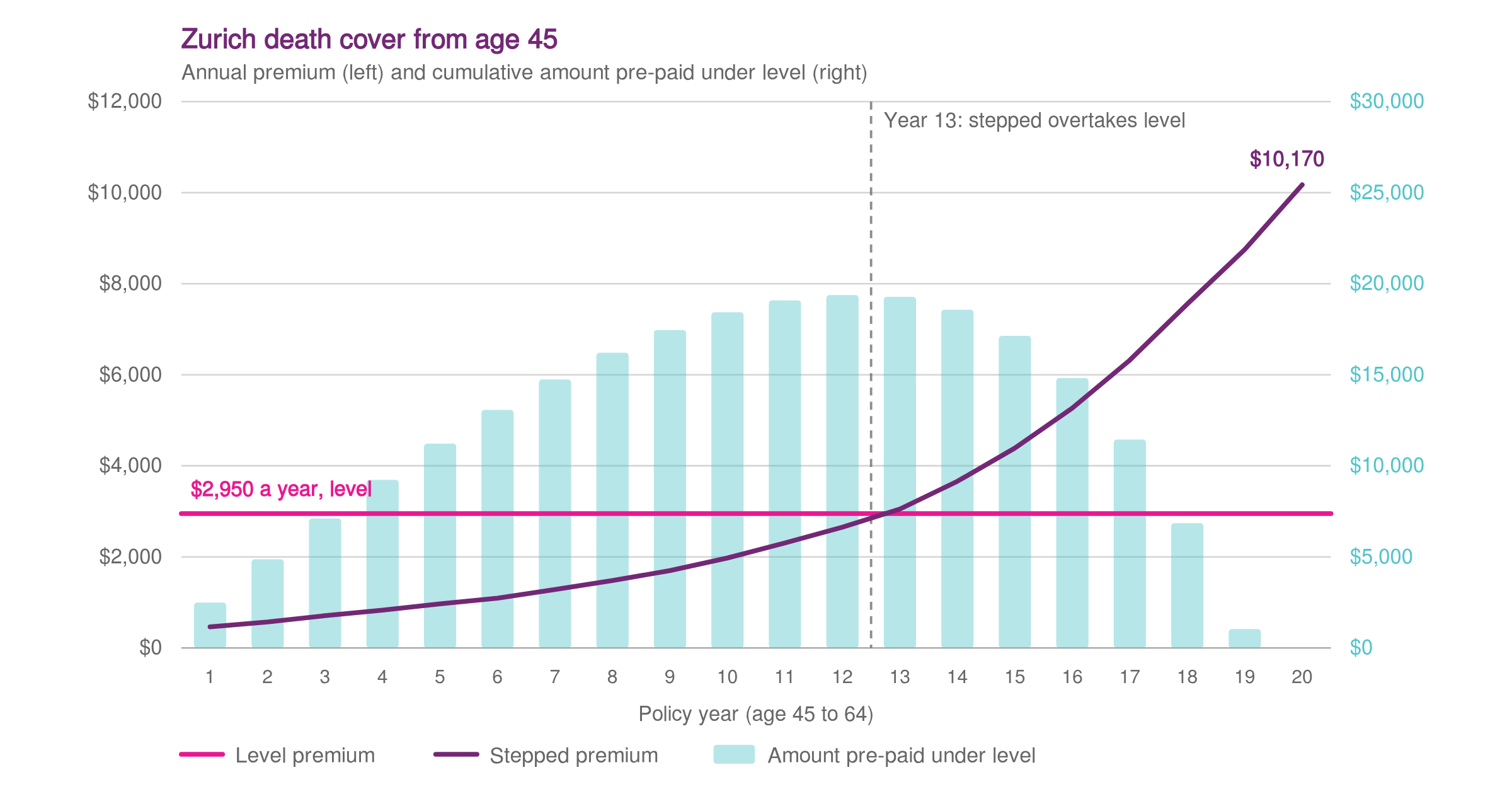
| Zurich | $463 | $2,950 | 6.4x | Year 13 | Year 20 | $10,170 |
Source: Keep Insurance analysis of insurer premium projections, death cover, starting age 45, August 2026. "Breaks even" is the first projection year in which total stepped premiums paid to date equal or exceed total level premiums paid to date, before any allowance for interest.
Three Things Stand Out
The year one gap is large. The level premium at 45 costs five to six and a half times the first-year stepped premium. That's the money going out the door up front.
It takes 12 to 13 years for the annual stepped premium to overtake level. Only from that point does level start giving anything back.
It takes 18 to 20 years - 19 on average - for total costs to break even. That's one year short of the point at which the level premium converts to stepped anyway.
Interest changes the breakeven
And that breakeven assumes the forced savings earn nothing. Apply a modest 3% p.a. return to money the client would otherwise have kept, and for two of the four insurers stepped never catches up within the full 20 years. At 5% p.a., three of the four never catch up.
Cover type comparison
Does This Hold for TPD, Trauma and Income Protection?
No - and this is the most important qualification in the post. Death cover is the least favourable case for level premiums. Run the same comparison at the same starting age across the other cover types and the picture changes materially.
Swipe sideways to see more
| Cover type | Insurers compared | Level as multiple of year 1 stepped | Year stepped overtakes level | Year total cost breaks even |
|---|---|---|---|---|
| Death cover | 4 | 5.0x - 6.4x | Year 12 - 13 | Year 18 - 20 |
| TPD | 6 | 2.0x - 5.5x | Year 8 - 11 | Year 12 - 16 |
| Trauma | 6 | 2.0x - 4.3x | Year 8 - 12 | Year 14 - 19 |
| Income protection | 5 | 2.1x - 2.6x | Year 7 - 10 | Year 14, 16, 17, and sometimes not reached by year 20 |
Source: Keep Insurance analysis, starting age 45, August 2026. "Insurers compared" counts only those returning a complete stepped and level projection pair for that cover type. Ranges show the spread across those insurers.
Level premiums are available on income protection - five of the seven insurers quoted offered them - and the upfront gap there is the smallest of any cover type, at roughly one and a half to two and a half times the stepped premium rather than five to six. TPD and trauma sit in between, with breakeven arriving four to six years earlier than death cover.
So "is level worth it?" isn't one question. It is a different question for each cover in your income protection and TPD arrangements, and it is entirely reasonable to answer it differently for each.
Trade-offs
What You Give Up to Get There
Even a marginal cost outcome might be worth it for budgeting certainty. But that certainty comes with conditions.
- Leaving early is expensive. The extra premium paid in the early years is not refundable. On the death cover figures above, the amount pre-paid peaks at between 5.7 and 6.6 times a single year's premium, at around year 11 or 12 - which is roughly the point at which level finally starts looking like the cheaper option. Cancel before then and you have paid for cover you will never receive. If you're looking at Level Premiums, make sure you expect to hold the policy for long enough to not lose the savings.
- Switching gets harder, not just costlier. That forfeiture makes clients materially less likely to move insurer - assuming moving is even available, which it may not be if their health has changed since underwriting. This optionality (being able to switch) has real value - it is worth giving up for more regular premiums?
- Fewer product options. Some features may not be available on level premiums. Premium pause is a common example. If any of the options impacted are important, or could become important, you will need to weigh up the pro's and con's.
- There is a price shock waiting at 65. In the projections above, the year 20 stepped premium lands at 3.4 to 4.6 times the level premium the client had been paying. That arrives at a point when many people are reducing cover or income, not increasing either.
Cost drivers
What Determines the Cost of a Level Premium
Level premiums are priced on the same underwriting factors as stepped - age, sum insured, gender, smoking status, occupation, health history and any loadings or exclusions. Two things matter more for level than for stepped:
- Your age when the policy starts sets the rate for the entire level period. Starting at 35 rather than 45 doesn't just lower the premium, it lengthens the runway over which the structure can pay off. This is why the case for level is stronger at younger ages.
- The conversion age. A policy that holds level to 70 gives you five more years of benefit than one converting at 65.
Indexation matters too. If you index your sum insured, the level premium is no longer flat - it rises with the cover amount. The figures in this post assume no indexation.
Switching
Can You Switch Between Stepped and Level Later?
Often, yes - many insurers allow a change of premium structure on an existing policy without new underwriting. The catch is that the level premium is calculated at your age at the time of the change, not your original age. Waiting five years to switch to level means paying a 50-year-old's level rate, not a 45-year-old's.
Going the other way - level back to stepped - is usually simpler, but the extra you have already paid is gone. It does not convert into a reduced future premium.
Switching to a different insurer is a separate matter entirely and requires fresh underwriting. If your health has changed since you first applied, that option may be limited or unavailable.
Final thoughts
Final Thoughts
Level premiums are sold on a simple promise: pay more now, pay less later, know where you stand. For death cover starting at 45, the "pay less later" part arrives so close to the end of the level period that most clients will never see it, and leaving before then is costly. For TPD, trauma and income protection the case is meaningfully stronger, and worth running the numbers on rather than assuming either way.
The better question isn't "stepped or level?" It's "what am I paying for the certainty, and how long do I have to stay in order for it to make financial sense?"
One closing thought on the insurer side of this. The extra premium collected early on a level policy is meant to fund cover in later years - so when a policy lapses before those years arrive, the insurer keeps money set aside for a claim it will now never pay. Level policies do lapse less often than stepped ones, partly because of the forfeiture described above, but the amount at stake per lapse is large. Combine that with a year one price five to six times the stepped alternative, and for death cover at least it's hard to read as anything other than the tradie scenario: a price set for a job the insurer would rather not do.
If you want the background on how retail life cover works in Australia, we've covered that separately.
Assumptions
Assumptions and Caveats
General information
This is general information only. It does not take your objectives, financial situation or needs into account, and it is not a recommendation to choose one premium structure over another.
The following specific factors could change the result for you:
- Starting age drives almost everything. This modelling starts at 45. At younger starting ages the year one gap is smaller and the level period longer, both of which move breakeven earlier.
- These are quoted standard rates. A pre-existing condition, a loading or a non-standard occupation will change your pricing, and may change it differently for each structure.
- First-year and ongoing discounts are not modelled. Several insurers apply a first-year discount that reduces the year one premium but not later years. Because insurers discount level and stepped differently, a discount applied to one structure and not the other can move the breakeven year by more than a year in either direction.
- No indexation is applied. The sum insured is held flat throughout.
- Projections are not guarantees. Insurers can and do reprice level premium books. Projected future premiums are estimates, not contractual commitments.
- The effective interest assumption is illustrative. The 3% and 5% figures show the sensitivity of the breakeven point. They are not a forecast, and are effectirvely after tax and fees.
- Insurer coverage varies by cover type. Seven insurers were quoted, but not all returned a complete stepped and level pair for every cover. Counts are shown in the comparison table.
If your situation is complex, or the sums insured are large, speak to a licensed financial adviser before making a change.
Frequently Asked Questions
What is the difference between level and stepped premiums?
A stepped premium is recalculated each year based on your age, so it rises over time. A level premium is calculated at your age when the policy starts and holds that rate until a set age, usually 65, at which point it converts to stepped. Level does not mean guaranteed - insurers can still reprice the underlying rates for everyone in a product.
Are level premiums cheaper than stepped premiums over the long term?
Eventually, but for death cover it can take most of the policy term. In modelling of death cover from age 45 across four retail insurers, the annual stepped premium did not overtake the level premium until year 12 or 13, and total premiums paid did not break even until between year 18 and year 20. The level premium converts to stepped at age 65, which is year 20 in this scenario. Breakeven arrives considerably earlier for TPD, trauma and income protection.
How much more does a level premium cost in the early years?
It depends on the cover type. For death cover at age 45, the year one level premium was between five and six and a half times the year one stepped premium. For TPD it was three to five and a half times, for trauma around two and a half to four times, and for income protection roughly two to two and a half times.
Are level premiums available for income protection insurance?
Yes. Five of the seven insurers quoted for this analysis offered a level premium option on income protection. The upfront cost gap on income protection is the smallest of any cover type, at roughly two to two and a half times the stepped premium, and the annual stepped premium overtook level between year 7 and year 10.
Which Australian insurers offer level premiums?
Of the seven insurers quoted in August 2026, MetLife, NEOS, OnePath and Zurich returned level premium projections for death cover. Level options were more widely available on TPD, trauma and income protection, where AIA and TAL also offered them. Availability changes over time and several insurers have narrowed or withdrawn level premium offerings in recent years.
What happens to my level premium at age 65?
Most level premium policies convert to stepped premiums at age 65, though some hold level to 70. In this modelling the stepped premium in year 20 was between 3.4 and 4.6 times the level premium the client had been paying, so conversion can represent a significant increase at a point when many people are reducing cover or income.
What do I lose if I cancel a level premium policy early?
The extra premium paid in the early years is not refundable. On the death cover figures modelled, the cumulative amount pre-paid peaked at between 5.7 and 6.6 times a single year's premium, at around year 11 or 12. A client who cancels or switches at that point has paid for cover they will not receive.
Can I switch from stepped to level premiums with my insurer?
Many insurers allow a change of premium structure on an existing policy, often without new underwriting. However the level premium is calculated at your age at the time of the change, not your original age, so the longer you wait the more expensive level becomes. Switching to a different insurer is separate and requires fresh underwriting, which may be limited if your health has changed.
What determines the cost of a level premium?
The same underwriting factors as stepped cover - age, sum insured, gender, smoking status, occupation, health history and any loadings. Two factors matter more for level: your age when the policy starts, which sets the rate for the whole level period, and the age at which the policy converts to stepped. Indexing your sum insured will also cause a level premium to rise.
Do level and stepped premiums apply to health insurance?
No. Level and stepped are life insurance terms. Private health insurance in Australia is community rated, meaning insurers cannot price your cover on your age or health at the time you join. The age-related loading that applies to health insurance is Lifetime Health Cover loading, which works differently and is not the same as a stepped premium.
Is there a stepped versus level premium calculator?
Generic calculators can illustrate the concept, but the breakeven point depends on your actual quoted rates, which vary considerably between insurers. The most reliable approach is to compare stepped and level quotes for your own age, cover type and sum insured across multiple insurers before deciding.
How can I manage rising stepped premiums without going level?
Review whether the sum insured still matches the need, since cover set against a mortgage years ago is often larger than required. Check whether optional riders added at application are still relevant. Compare rates across insurers, which vary considerably at the same age. Consider how the cover is owned and structured. Level is one option but it is the least reversible.
Compare quotes and start saving
Real-time quotes from leading Australian insurers in five minutes — no email required.